Museum exhibitions are displays of objects, artworks, or ideas arranged to help visitors encounter and interpret them. You can connect with an exhibition by looking closely, reading selectively, listening, talking with others, and relating what you see to your own experience. These approaches matter: the American Alliance of Museums reports that U.S. museums welcome hundreds of millions of visits annually, making exhibitions an influential setting for learning and cultural exchange. Below are practical ways to engage, from slow looking and interpretation to accessibility, conversation, and thoughtful planning.
Museum Exhibition Engagement: Meaning and Value
Museum exhibition engagement is the active process of noticing, interpreting, and responding to objects and ideas on display. The International Council of Museums (ICOM) defines a museum as a permanent, not-for-profit institution that researches, collects, conserves, interprets, and exhibits tangible and intangible heritage for education, study, and enjoyment. Engagement therefore extends beyond simply viewing objects: it includes asking questions, making connections, and considering how exhibitions shape meaning.
There is no single correct way to participate. A visitor might spend several minutes with one painting, follow a curator’s route, join a guided tour, use an audio description, sketch, or discuss an object with a companion. The Smithsonian’s Office of Policy and Analysis has emphasized that visitors arrive with different interests, knowledge, and expectations, so varied interpretive approaches can help exhibitions serve a wider public.
Slow Looking and Close Observation
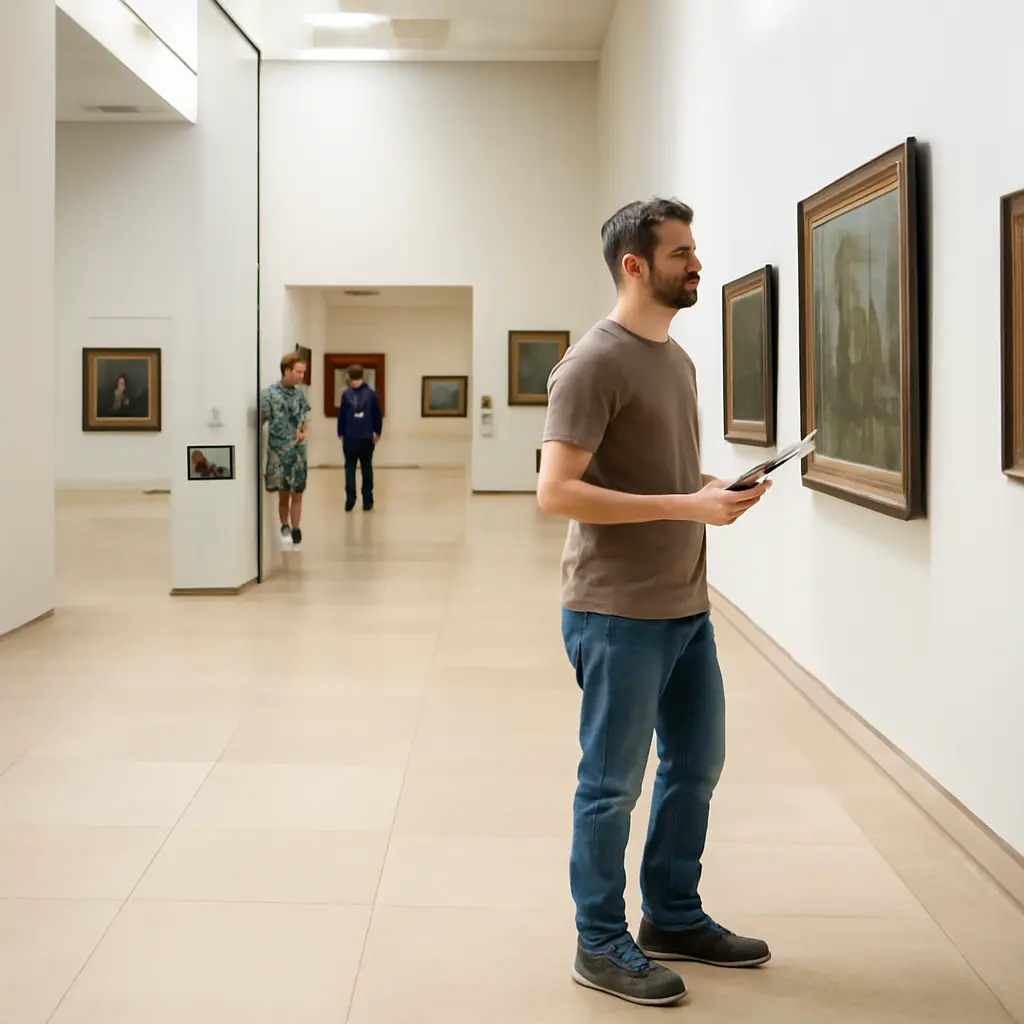
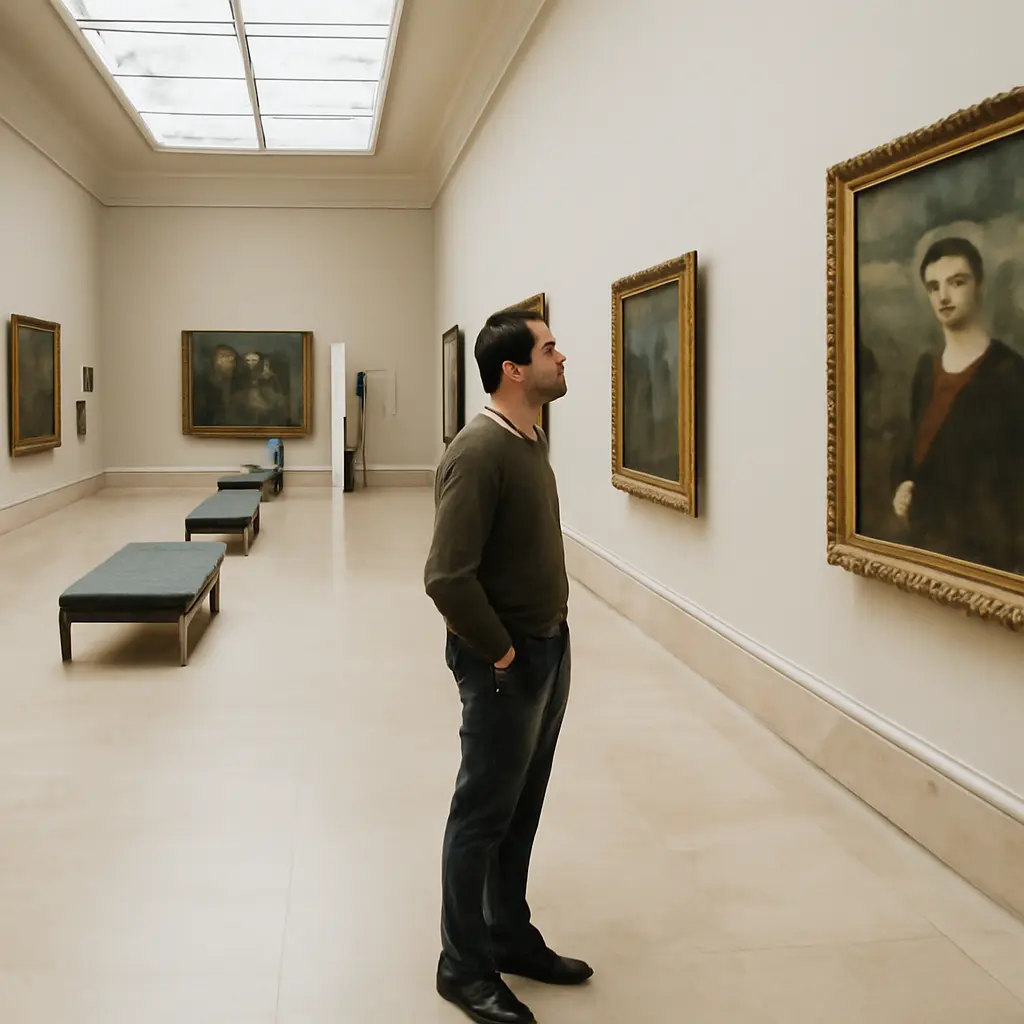
Slow looking means deliberately giving an artwork or object sustained attention before deciding what it means. Start with observable details: What materials, colors, shapes, gestures, or patterns do you notice? Then ask what those choices might suggest. The Harvard Project Zero routine “See, Think, Wonder” offers a simple sequence: describe what you see, explain what you think is happening, and identify what you wonder about.
This method can make a brief visit feel richer without requiring specialist knowledge. In a widely cited study, psychologist Mihaly Csikszentmihalyi and researcher Rick Robinson examined how people experience objects in museums and found that personal associations and reflection can be central to meaningful encounters. Try choosing one object and returning to it after reading its label; notice whether context changes your interpretation.
Reading Labels and Exhibition Design
Labels, wall texts, maps, and object placement are forms of interpretation: they provide context and guide attention. Read a short label after observing the object, rather than allowing the text to dictate your first response. Compare the object’s visible details with information about its maker, date, materials, original use, or cultural setting.
Exhibition design also communicates through sequence, lighting, scale, and proximity. Two objects placed side by side may invite comparison even when their labels do not explicitly make one. Ask why an object appears in this room, what is included or omitted, and whose perspective the exhibition presents. These questions connect personal looking to the larger work of museums as interpreters of history and culture.
Museum Exhibition Interpretation: Routes to Deeper Connection
Interpretation is the process of making meaning from an exhibition using evidence, context, and personal response. It is not simply guessing what an artist intended. A useful interpretation distinguishes what is directly visible from what is inferred, then remains open to additional information. This approach is especially valuable when exhibitions address unfamiliar traditions, contested histories, or multiple viewpoints.
Personal Connections and Reflection
Personal connection means relating an object to memories, emotions, questions, or experiences while recognizing that your response is one perspective among many. A landscape might recall a place you know; a portrait might prompt questions about identity or representation. Jotting down a few words or making a quick sketch can help preserve these responses.
Reflection becomes more meaningful when paired with curiosity about context. Consider both “What does this bring to mind for me?” and “What might this object have meant to the people who made or used it?” Museums increasingly use visitor-centered interpretation to invite these questions, but personal resonance should not replace the object’s cultural and historical context.
Conversation, Tours, and Shared Looking
Shared looking is discussing an object with another visitor, educator, or guide. Different people may notice different details, and respectful conversation can reveal assumptions that solitary viewing leaves unexamined. Ask open questions such as “What detail stands out to you?” or “What makes you say that?” before offering an interpretation of your own.
Guided tours provide structured context and opportunities for questions, while family or peer conversations can connect exhibition themes to everyday life. Research on museum learning, including work by the National Research Council and the Institute of Museum and Library Services, highlights that learning can be shaped by visitors’ prior knowledge, social interactions, and the physical setting. A tour is one option, not a requirement: visitors can also use a museum’s printed guide or join a scheduled discussion.
Digital, Audio, and Hands-On Interpretation
Digital interpretation includes audio guides, captioned video, touchscreen stations, online collections, and augmented-reality features. These tools can add voices, translations, maps, or close-up views that are difficult to provide through a label alone. Use them selectively: a device can deepen attention, but it can also draw it away from the physical object.
Hands-on areas and interactive stations offer another route, especially for visitors who learn by doing. The Association of Science and Technology Centers describes informal learning as voluntary and often driven by personal interest, a principle relevant to interactive experiences across museum types. Check posted instructions and access options, and remember that participation may be observational rather than physical.
Museum Exhibition Access: Inclusive Ways to Participate
Accessible engagement means providing ways for visitors with different sensory, mobility, communication, language, and cognitive needs to take part. The U.S. Census Bureau’s American Community Survey reports that roughly one in four U.S. adults has a disability, underscoring why accessibility is a core part of exhibition planning rather than an optional extra. Visitors can check a museum’s access information in advance, while institutions can offer multiple formats and routes through an exhibition.
Sensory and Mobility Access
Sensory access can include audio description, large-print or Braille materials, captioning, sign-language tours, quiet spaces, and advance information about sound or lighting. Mobility access may involve step-free routes, seating, elevators, and clear pathways. The Smithsonian Accessibility Program provides examples of resources museums can use to improve participation for visitors with disabilities.
Before visiting, look for details about entrances, restrooms, seating, service animals, and sensory conditions. During a visit, ask staff about alternatives if a display is hard to see, hear, reach, or navigate. Accessibility benefits many visitors, including older adults, families with young children, and people managing temporary injuries or fatigue.
Language, Representation, and Cultural Context
Language access involves clear writing, translations, and interpretation that does not assume every visitor shares the same background knowledge. Representation concerns whose stories and expertise appear in an exhibition, and how cultural objects are described or presented. These questions are especially important for Indigenous collections, objects acquired under colonial conditions, and histories shaped by unequal power.
ICOM’s 2022 museum definition explicitly emphasizes accessibility, inclusivity, diversity, sustainability, and ethical communication. Visitors can engage critically by noticing who speaks in labels, whether community perspectives are included, and how museums explain an object’s history and ownership. Such questions do not diminish an exhibition; they help visitors understand how knowledge is produced and shared.
Museum Exhibition Visit: A Practical Approach
A thoughtful visit does not require seeing everything. The American Alliance of Museums’ field-wide reporting documents the scale and diversity of U.S. museum participation, but a meaningful encounter can be as small as closely examining one object. A simple plan helps visitors balance discovery, rest, and reflection.
Before, During, and After the Visit
Before visiting, check opening hours, admission details, exhibition themes, accessibility information, and any photography or bag policies. Choose one question to carry into the galleries, such as how materials convey status or how an artist represents a place. During the visit, alternate between looking, reading, and taking breaks; afterward, note one object or idea you want to remember.
The following compact routine can make a visit more focused:
- Choose one gallery or theme rather than trying to cover everything.
- Spend a few quiet minutes observing an object before reading its label.
- Use one interpretive resource, such as a tour, audio guide, or exhibition map.
- Discuss or write down one question that remains unresolved.
- Take a rest break and revisit a work that changed your thinking.
A Real-World Example: Looking at a Familiar Masterpiece
At the Art Institute of Chicago, visitors encountering Grant Wood’s American Gothic can begin with visible evidence—the figures’ expressions, clothing, posture, and the pitchfork—before reading about the painting’s 1930 creation and its place in American visual culture. Looking first encourages independent observation; context then opens questions about rural identity, satire, and how audiences have interpreted the image over time. The same sequence works with an unfamiliar object: observe, gather context, compare interpretations, and revise your understanding.
Conclusion: Connect with Museum Exhibitions on Your Terms
Museum exhibition engagement can begin with slow looking, grow through interpretation and conversation, and become more meaningful when access and cultural context are considered. You do not need expert knowledge or a long visit: choose an object, notice its details, ask a question, and remain open to other perspectives. Museums, in turn, can support richer encounters by offering inclusive formats and transparent interpretation. On your next visit, try one new approach and explore the museum’s accessibility resources, online collection, or guided programs to continue learning.
Sources: International Council of Museums, Museum Definition, 2022, https://icom.museum/en/resources/standards-guidelines/museum-definition/; American Alliance of Museums, Museum Facts, https://www.aam-us.org/programs/about-museums/museum-facts/; Harvard Project Zero, Artful Thinking, https://pz.harvard.edu/projects/artful-thinking; Mihaly Csikszentmihalyi and Rick E. Robinson, The Art of Seeing: An Interpretation of the Aesthetic Encounter, 1990, https://www.getty.edu/publications/virtuallibrary/0892361568.html; Smithsonian Institution, Office of Policy and Analysis, Visitor Studies, https://www.si.edu/opanda; National Research Council, Learning Science in Informal Environments: People, Places, and Pursuits, 2009, https://nap.nationalacademies.org/catalog/12190/learning-science-in-informal-environments-people-places-and-pursuits; Institute of Museum and Library Services, Museums, Libraries, and 21st Century Skills, https://www.imls.gov/issues/national-initiatives/museums-libraries-and-21st-century-skills; Association of Science and Technology Centers, Informal Science Learning, https://www.astc.org/; U.S. Census Bureau, American Community Survey, Disability Characteristics, https://data.census.gov/; Smithsonian Accessibility Program, https://access.si.edu/; Art Institute of Chicago, Grant Wood, American Gothic, https://www.artic.edu/artworks/6565/american-gothic.